Thứ Tư, 24 tháng 12, 2014

Halong most famous cuisines

Sea snalis – a half of Ha Long’s cuisine
It might be a little overstated to say that half of Ha Long cuisines are dishes made from sea snails, but this is to emphasize the significant contribution of this irresistible food stuff to Ha Long gastronomy.
There is no precise estimation on how many types of sea snails are edible in this beautiful bay. Huan, a local fisher said that he had seen about 20 kinds of see snails so far. The fisherman continued his story about sea snails by listing their name respectively, however, after three repeating times, this unprofessional tour-guide decided to try out directly that extraordinary creature would be the best way to “taste” Ha Long.
Halong most famous cuisines

Halong Sea Snails - Try it and love it
Cao Xanh market and Bai Chay market are the most popular spots where sea snails are supposed to be sold with the best quality. Wandering around Bai Chay, which is crowded with people eating on the sidewalks, every one can see a panel with the title: “Ha Long snail super market” that excitingly catches visitors’ eyes. Having a look through the restaurants’ menus, visitors would surely be surprised at the diversity of sea snails here.
With only one bowl of sauce made from fish-sauce, ginger, peppers and lemongrass, each type of snails with different unique flavors and different ways to enjoy would make anyone's mouth water. Eaters enjoying snails are advised to drink hard beverages such as alcohol to avoid stomachache.
The other half of Halong’s cuisines: seafood derivatives. halong bay cruises
Visitors must be excited when served special liquor named “Ngán - Arca Wine” (“Ngán” is a species of Veneridae). This special drink is actually a mixture of typically Vietnamese rice wine and “Ngán” blood, which is supposed to benefit men’s sexual ability. After the mixture is completed, the wine transforms into a light red color with totally a different flavor. Spirit followers cannot wait to drink it, to feel an immediate absorbent into their bodies.
Halong Seafood
Ngan or Arca to make the wine
Another well-known alcohol named “Hoanh Bo” should definitely not be missed when visiting Ha Long. With low volume of alcoholic, the liquor is not tough to conquer, yet some people who consumes too much Hoanh Bo need 2-3 days to sober.
Ha Long is also famous for squid-sausages, which is told to be delicious and fragrant only when processed by restaurants here. The food is a fusion of hashed squid and mysterious spices that only the chefs know, molded into round pieces and then fried in boiling oil. This special dish can be found anywhere along the shore from Quang Ninh to Hai Phong, but nowhere has the same level of deliciousness like in Ha Long.
Squid sausage
Squid sausage - Halong's most famous dish
The diversity of shrimps, from the luxurious one like lobsters to the other common shrimps, is another outstanding feature of cuisine in Ha Long. To many local people, a dish of streamed shrimps, served with lemonadized salt and a dish of freshly spicy vegetables, is an ideal meal for a joyful friendly union.

Thứ Tư, 17 tháng 12, 2014

Halong Bay Vietnam

Geographical position

Situated in the north-east region of Viet Nam, Halong Bay is a part of Bac Bo Gulf and comprises the sea area of Halong City, Cam Pha Town and a part of Van Don island district, Quang Ninh Province. It borders Cat Ba Island to the south-west, the mainland to the west with a 120km-long coastline.

Natural Beauty

Halong Bay covers a total area of 1,553km², including 1,969 islands of various sizes, 989 of which have been given names. There are two kinds, limestone and schist, which are concentrated in two main zones: the south-east (belonging to Bai Tu Long Bay) and the south-west (belonging to Halong Bay). The average geological age of the islands is between 250 and 280 million years old.  Halong bay tours

Halong Bay has been called by the great national poet Nguyen Trai: "a marvel of the earth erected towards the high skies". While exploring the bay, tourists will feel lost in a legendary world of stone islands which shapes change depending on the angle and the light. There are many names given to islands according to their shapes and forms such as Hon Dau Nguoi (Human Head Islet), Hon Rong (Dragon Islet), Hon Canh Buom (Sail Islet), Hon Trong Mai (Cock and Hen Islet)… But the beauty of Halong Bay does not consist only in the forms of its mountains, islands and the colour of its waters, but also in its infinitely rich system of grottoes and caves such as: Thien Cung (Heavenly Palace Grotto), Dau Go (Driftwood Grotto), Sung Sot (Surprise Grotto), Tam Cung (Three Palace Grotto), Trinh Nu (Virgin Grotto)…. Each is a grandiose and refined natural architectural creation.
Halong Bay Vietnam
Halong Bay Vietnam
 
Geological value

The most remarkable geological events of Halong Bay’s history in the last 1,000 years include the advance of the sea, the raising of the bay area and the strong erosion that has formed coral and pure blue and heavily-salted water. This process of erosion by sea water has deeply engraved the stone, contributing to its fantastic beauty. Present-day Halong Bay is the result of this long process of geological evolution that has been influenced by so many factors. It is because of all these factors that the tourists now visiting Halong Bay are not only treated to one of the true wonders of the world, but also to a precious geological museum that has been naturally preserved in the open air for the last 300 million years.

Value of biological diversity

Results of scientific research show that Halong Bay features ecosystems of a tropical ocean region such as ecosystem of coral reefs with 232 species of coral distributed mainly in the areas of Cong Do and Bo Hung. It is also home to 81 species of gastropoda, 130 species of bivalvia, 55 species of polycheta and 57 species of crab. The ecosystem of salt water-flooded forests chiefly concentrated in the zones of Tuan Chau, Cua Luc and Ba Che has the most diversified collection of species of salt water-flooded plant in North Vietnam. Also living in this ecosystem are a great many species of animals: migrating birds (200 species), polycheta (169 species), seaweed (91 species), reptile (10 species). Halong Bay also has ecosystem of tropical rain forests with various rare and precious creatures: deer, weasels, squirrels and in particular, white-tabby and red-haired monkeys. In addition, there is a system of small caves along the sea, which are the living and development places for many animals and plants: seaweed, water plant, algae, fish and shrimp. Deeper into the water, there are also many species of shrimp, fish, abalone and other sea-specialities.

Historical and cultural value

Halong is a place closely linked to Vietnam’s history with such famous geographical names as: Van Don (site of an ancient commercial port); Poem Mountain (with engravings of many poems by emperors and other famous people of the past); and Bach Dang River (the location of two fierce naval battles fought against foreign aggressors). This is not all, Halong has been proven by scientists to be one of the first cradles of human existence in the area, with such archaeological sites as Dong Mang, Xich Tho, Soi Nhu and Thoi Gieng…

On December 17, 1994, Halong Bay was recognised as world natural heritage for its natural beauty at the 18th meeting of the World Heritage Committee of UNESCO in Thailand. On December 12, 2000, Halong Bay was recognised as world natural heritage for the second time based on its geological value at the 24th meeting of the World Heritage Committee of UNESCO in Cairns, Australia. The recognised site covers an area of 434km², comprises 775 islands and forms a triangle: with Dau Go Island (Driftwood Grotto) to the west; Ba Ham Lake (Three Shelter Lake) to the south and Cong Tay Island to the east.

Thứ Hai, 8 tháng 12, 2014

Halong Ginger cruise

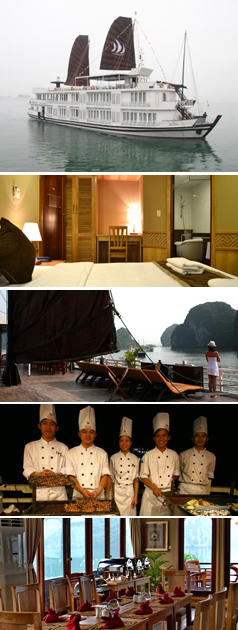
The Halong Ginger cruise is the perfect mix of classical and modern. It has three decks, that shine polished wood under its golden sails. With two bars, a restaurant, and a luxurious spa, this cruise are perfect to unwind and relax while taking in the beauty of the Halong Bay.

Watch the islands pass by the blue shimmering waters while you sail towards Cua Van, the oldest and largest fishing village in Halong Bay. There are a lot of good reasons to choose Halong Ginger for your cruise of Halong Bay, one of which being the exquisite beauty of the boat itself. Tours to Vietnam

Itinerary
Halong Ginger cruise

After getting picked up in Hanoi, if you opted for that, you will be taken to Halong Bay where you will find the Halong Ginger in all its glory.

The ship will set sail as passengers are served a lunch. During the days you can cruise the bay and the beaches, or you always have the option of a massage and sunbathing. Along the bay you can go trekking or swimming at Soi Sim Island and then cruising to visit Hang Doi water tunnel with row boat.

There are plenty of caves and mountains to explore before you get back to the Halong Ginger for dinner. Then wake up the next day with Tai Chi ready to explore more of the beautiful the bay has to offer. Visit grottos and fishing villages all along the bay area. There are so many things to see that you certainly won't get bored on the three days and two night option.

Who this cruise is best for:

The Halong Ginger is a good choice for anyone who wants to see the beauty of Halong Bay and its islands. If you have a medical condition, I wouldn't suggest the trecking in the caves. If you are looking to relax, sight see, take in the sun, and do all of that in luxury, the Halong Ginger cruise might just be perfect for you and your family.

Thứ Tư, 26 tháng 11, 2014

Vung Vieng fishing village

Far 24km from the mainland, Vung Vieng fishing village is located in the center of Bai Tu Long Bay to the northeast of Halong Bay tours. This is a peaceful place with the beautiful scenery and features with the traditional culture of fishermen living around the Bay all year round. Coming to Vung Vieng fishing village, you will have a chance to learn how to use fishing net or fishing rod from the local fisherman at this area.

Vung Vieng has attracted lots of travelers for years by its beauties like pretty fishing boats, fish’s cages being in front of floating houses of local people, especially friendly and helpful fishermen, children with happiness on their faces on the way to school,… Everything makes this village become an attractive destination in Halong Bay Heritage.

There are only about 60 floating houses meaning 60 families in this village. You will definitely surprise when seeing these small village with only tens of pretty floating houses in which every activities of the day life or important event of the village happen while bobbing in the middle of the bay. The amazing pictures that your eyes can catch here are simple small floating houses, films on old televisions, a woman cooking the dinner while children playing traditional games in front of the houses and the husband preparing for his fishing trip at night,…These pictures will bring you special memories about people here and the sense of peace in your holiday in Halong Bay.


Almost people here live on fishing and aquaculture but there are several people do small business on their boats by selling miscellaneous goods for other ones and tourists. That’s one of the features in Halong Bay maybe you like because you can by something like snack, water,… from them while cruising on the bay but it’s quite expensive. Recently, when tourism has growth, Vung Vieng became famous place that is included in itineraries of travel companies. In order to explore this place, tourists can hire either kayak to discover bu yourself or small boats rowing by local people. These services are provided by cruise company and local people which brings more revenue for their families.

Thứ Ba, 18 tháng 11, 2014

Story about unique horse-drawn carriage in Bac Ha

Horse in Bac HaA horseman, deeply attached to the northern mountainous Lao Cai province’s Bac Ha Plateau, has expressed his love for the area as he carries tourists in a horse-drawn carriage.
Hoang Van Chu of the Nung ethnic sects, who lives in the province’s Na Hoi Nung Village of Na Hoi Commune, is the first admirer of the ‘White Plateau’ to build a horse carriage and earn his living by transporting tourists in the carriage. North Vietnam tours
“It’s easy for tourists to find a vehicle to travel everywhere on the Plateau, as there are modern vehicles in the area, including motorbikes and minibuses. However, anyone who is well-experienced in travelling will choose the horse carriage,” Chu said.
A carriage ride with a view of the imposing mountain landscape gives tourists the impression of being on vacation and makes them feel a bit like “royalty”. Hanoi & Sapa Homestay 6 days

Travelling the Bac Ha Plateau, tourists will be impressed with the colourful ethnic costumes, the horses’ neighs, and the screams of mountain pigs intermingled with the sounds of hammers on the fires of blacksmiths. In particular, tourists will have the opportunity to enjoy Tam Hoa plums, a tasty specialty of the area.
“Many tourists visiting the plateau shared with me that travelling by horse carriage helped them leisurely enjoy the area’s landscape and take souvenir photos,” Chu said.
He is skillful at shooting and horse straddling and a famed horseman in the area, having learnt how to ride a horse and fire a gun in early childhood.
Horse in Bac Ha 1“My parents told me there were many horse carriages in my hometown during the years of French colonialism, from 1857 to 1945. At that time, the horse carriage was one of the specific features of Bac Ha Plateau. Local residents mostly used horses for transport. Only the rich could ride in carriages,” Chu said.
Story about unique horse-drawn carriage in Bac Ha
However, such kinds of vehicles gradually fell into oblivion, and were changed over to modern vehicles. “There were no horse carriages on any roads in the area since the 1990s,” Chu said.
The sound ‘click clock click clock’ of horses’ hooves and the tinkling of the tintinnabula bells on their necks gradually faded in local residents’ memories, which saddened the horseman Chu.
After much searching of his heart, Chu decided to go to China and order a horse-drawn carriage from a Chinese worker, with the aim of bringing back a specific tradition of the plateau. “The Chinese man delivered a horse carriage on time. Yet, the carriage he made couldn’t satisfy me because it was not convenient for carrying tourists,” Chu said. Travel to Vietnam
Not giving up, Chu was determined to make a horse carriage on his own. The vehicle was completed and used as to serve tourists in the area, which surprised all local residents.
“Some of my neighbours sneered at me, and called me a ‘madman’. They thought that there would be no tourist to use a horse carriage on their trips. Yet, I ignored all the ridicule and continued making shoes and tintinnabula for my horse,” Chu said.
Horse in Bac Ha 2
At first, Chu carried tourists free of charge along the most beautiful destinations in the area, such as Hoang A Tuong edifice, Trung Do Temple and on misty paths, in a bid to build reputation for his service, as well as advertise the beauty of his hometown.
“Foreign visitors often called me a ‘cowboy’. Some of them told me that during their trips in Bac Ha Plateau, they loved most of all the sound of horses’ hooves on road and the tinkling bells on the horses’ neck, which made me so happy,” Chu said.
Chu is the only one in the area who provides tourists with horse-drawn carriage rides. “I had to spend all my savings, worth VND60 million (US$2,800), to make my carriage. No one in the area dared to spend the sum as I did,” Chu said.
Besides Chu’s horse providing rides for tourists, there are many horses in the area to carry goods. Riders of baggage horses often gather in front of Bac Ha Temple ready for hire to carry goods, which is one of the area’s oldest jobs.

Thứ Năm, 6 tháng 11, 2014

Ben Tre travel guide

Ben Tre is a little province in the east of Mekong Delta, being wedged between two main arms of Tien River. Ben Tre shares borders with Tien Giang, Tra Vinh and Vinh Long. It has one township also called Ben Tre and 7 other small districts, including Ba Tri, Binh Dai, Chau Thanh, Cho Lach, Giong Trom, Mo Cay and Thanh Phu. The province also accounts for the greatest part of Khmer ethnic population of the region. Read more: Mekong river cruise
Ben Tre is known as the land of coconut and also the cradle of “Dong Khoi” (“simultaneous insurgency”). Recording some of the fiercest stages of the American-Vietnam War, Ben Tre is heard by most students of the two countries’ history.
The sleepy and laid back Ben Tre is usually bypassed by most visitors coming to the delta. Considering its unparalleled beauty and historical significance, however, this picturesque area is definitely well worth a visit.

Sights & Attractions

Phoenix Island
A visit to Bentre should include a boat trip to its several secluded islands. The first to be mentioned is the beautifully named Phoenix Islands (Con Phung). The island covers an area of 28 ha, emerging amidst the Tien River. Con Phung draws tourist attention mainly due to a coconut candy home factory located here. It is interesting to watch the entire manual making process of these Vietnamese fragrant sweets and taste some. The island is also famous with its coconut handicraft village.
The next stop is Dragon Island where you may fill your stomach with luscious tropical fruit and enjoy a yummy lunch with local specialties, typically included elephant ear fish, crispy southern spring rolls, sweet- sour soup and rice or noodles. On Unicorn Island, you may relax with honey tea and enjoy a local music performance of “Don ca tai tu”, a form of folklore opera in southern Vietnam.

Ben Tre travel guide
Vam Ho Bird Sanctuary
Vam Ho is a natural reverse area in Ba Tri District, around 57km from Ben Tre Township, accessible by road and boat. The sanctuary is home to thousands of stocks, cranes, herons and many other rare bird species. A network of arroyos was dug to water and protect the area from risks of fire.
The reserve also boasts rich flora (mainly mangroves) and fauna (bats, snakes, pythons, etc). It is best visited from 4 to 5pm everyday as the birds coming back to their nests after a day searching around for food. It may get very noisy with their flap of wings and their loud voices, but definitely a scene you may see once in a lifetime.

The historical relics & memorials
Ben Tre is homeland of the greatest female figure in Vietnam modern history, Madam Nguyen Thi Dinh. Her temple and memorial complex can be found in Phong Dien Hamlet, Luong Hoa Commune, Giong Trom District.
General Nguyen Thi Dinh was the soul of Dong Khoi revolutionary, first broke out in Mo Cay District of Ben Tre (1959), then spread out to the all other provinces of Mekong Delta. She was also the founder and leader of the renowned Vietnamese “long hair army” or “female guerilla troops”. You may also visit the Dong Khoi traditional house in Mo Cay District and relics of the Ho Chi Minh Trail on sea in Thanh Phu District.

Food & Drink
Numerous fruit orchards can be found in Cai Mon-Cho Lach, Tien Long and Chau Thanh districts: mango, longan, papaya, durian, jackfruit, rambutan, you name it. Interestingly, it is often sold to tourists not in kg but “belly sold” that means you pay a certain amount then pick up and eat to your full. The orchard owners may also offer you a delicious lunch of chicken specially raised by letting walk freely in the large orchards and find food themselves. Mussel rice is also a popular delicacy here.
Ben Tre is especially famous for coconut cake that is made from sticky rice mixed with black bean and rolled in strips of nipa young leaf. Making this cake is a time consuming and painstaking job. Rice is carefully chosen and soaked for several hours. Locals have to get up early to wash rice, extract young coconut milk and prepare wrappings. Cakes are fasten in clusters of a dozen and boiled for hours. The secret of making coconut cake is kept strictly and passed from generation to generation of the families.
A very popular drink not only in Ben Tre but around Mekong Delta in general is snake wine. It is supposed to be good for men and only men are allowed to taste them. Other widely available drinks are coconut alcohol and honey tea. Strolling around the bee farming villages in Mo Cay, Chau Thanh, Cho Lach and Giong Trom districts, you will be invited by vendors to visits their homes and taste some.

Getting there & away

There are two main ways to get to Ben Tre by road. From Ho Chi Minh City, you may follow the National Highway 1A to Trung Luong junction in My Tho- Tien GIang, turn right into National Highway 60 to Rach Mieu Ferry. Total distance is 86km and the ferry crossing takes around 22 minutes, ferry run 24 hours.
The second way is to travel from Can Tho to Vinh Long on National Highway 57. After crossing Dinh Khao Ferry to land on Cho Lach District, then continue to Ben Tre Township. Total distance is 50.7km.
Ben Tre can also be visited by boat down the Tien River.

Thứ Năm, 30 tháng 10, 2014

Kỹ thuật cho hươu sao ăn

- Cho ăn đúng cách: Hươu giống chủ yếu hoạt động vào ban đêm, ban đêm hươu ăn tới 60% tổng số thức ăn của khẩu phần, vì vậy mỗi lần cho ăn trong ngày không nhiều, ban ngày hươu ăn ít mà dành thời gian nhai lại thức ăn qua đêm. Đây là một đặc điểm hết sức quan trọng mà người chăn nuôi cần nắm biết. Vì vậy lịch phân bố cho hươu ăn như sau:

Bữa thứ nhất: 6-7 giờ sáng cho ăn 15% thức ăn xanh.
Bữa thứ hai: 9-10giờ sáng cho ăn 15% thức ăn xanh.
Bữa thứ ba: 13-14 giờ chiều cho ăn 10% thức ăn xanh cộng với thức ăn tinh trong ngày.
Bữa thứ tư: 17 - 18giờ tối cho ăn 30% thức ăn xanh.
Bữa thứ năm: 22 giờ tối cho ăn 30% thức ăn xanh.

- Thức ăn tinh không được cho hươu ăn vào buổi sang vì ăn như vậy sẽ làm cho hươu ăn ít thức ăn xanh và thức ăn củ quả. Nên cho hươu ăn thức ăn tinh vào bữa ăn thứ ba vào lúc 13 – 14 giờ trong ngày. Hàng ngày người chăn nuôi phải thường xuyên theo dõi phân của hươu để điều chỉnh thức ăn cho hợp lý. Thường phân của hươu có dạng viên bóng, cứng hình bầu dục nếu khác với bình thường thì cần xem xét lại thức ăn cho hươu.
  Vận động – Tắm nắng – tắm chải.
Cho hươu ăn nhiều loại thức ăn xanh, đặc tính của chúng là thích ăn nhiều loại cỏ non, lá non và các loại cây có mủ. Không nên cho hươu ăn độc nhất một loại thức ăn thì sinh trưởng và phát triển, khả năng sản xuất cho nhung huou tuoi sẽ bị hạn chế.

 
Kỹ thuật cho hươu sao ăn
a). Vận động: Tuỳ thuộc vào hình thức nuôi khác nhau nên cho hươu vận động khác nhau. Hươu là động vật con mang tính hoang dã nên rất thích vận động, chạy, nhảy rất hiếu động nên khi bị bó hẹp trong nuôi nhốt thì rất khó chịu. Chúng ta nên tạo diện tích sân chơi cho hươu bằng cách khoanh vùng rộng bằng rào chắn cao 2 – 2.5m thì khả năng vận động và tắm nắng cuả hươu thịt được tốt hơn và thích nghi với điều kiện sinh lý của nó hơn, ít gây ra các hiện tượng ức chế(stree) con vật thoải mái hơn, góp phần tiêu hoá, trao đổi chất được tốt hơn.

Nếu không có điều kiện thì cần phải thiết kế mái che có lắp tấm kính có độ rộng 40X50cm cho nắng rọi vào 1giờ/ngày. Có thể thiết kế chồng cho nắng xuyên vào chuồng 7-8 giờ/ngày.

b). Tắm chải. Thứ tự tắm chải từ đầu đến mông, từ trên xuống dưới, mỗi lần chỉ cần 5- 10 phút. Trước khi tám chải phải tập làm quen với con vật để tạo cho nó có phản xạ có điều kiện. Trong quá trình tắm chải chú ý phát hiện một số ký sinh trùng nư ve, ghẽ, lỡ, loét…Nếu có hãy dùng các biện pháp sau đối với ve, ghẽ…

Bắt diệt liên tục bằng cơ học.

Dùng Ivermactin điều trị nội ngoại ký sinh trùng để tiêm 1ml/7kg trọng lượng.

Dùng các thuốc sát trùng ngoài da và khử trùng chuồng trại. Định kỳ dọn vệ sinh chuồng trại.

Sau đây chúng ta hãy tìm hiểu cụ thể cách nuôi dưỡng mỗi loại hươu.

Halong Bay swimming activities

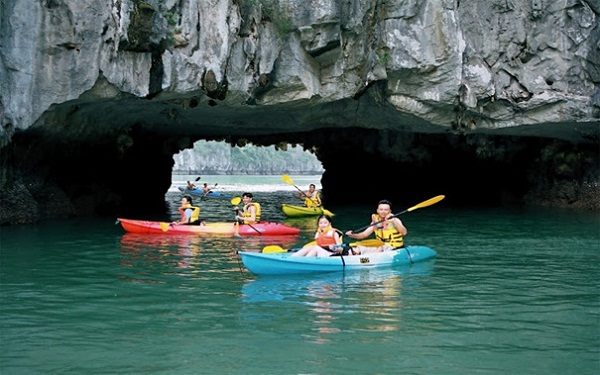
Halong Bay is a ideal travel destination - a World Heritage Site, with thousands of limestone islands and caves. There are countless places to stop for swimming, fishing, snorkeling and kayaking when cursing around islands. There are many charming and attractive beaches; it is suitable for swimming activities such as Tra Gioi Beach, Ba Cua Beach, Tuan Chau Beach, Titov Beach, Minh Chau Beach. Visit halong bay cruise
Halong Bay swimming activities
The stunning scenery of sheer mountain cliffs rising out of the bay makes an ideal backdrop to water-based activities.The water of beach is emerald green and turquoise color so you cannot see the bottom. Halong Bay is the safe place for swimming. Because beach is calm waters and tourists will be provided useful equipment such as: life jackets. Moreover the sailors and staff of the ship watched while you were swimming to alert you for dangers in case. Swimming in Halong bay is really nice and refreshing. visit halong long: 3 best places kayaking in Halong bay
 Swimming Safe guides:

- Check with the lifeguard on surf conditions before swimming. If lifeguards give you directions or instructions from the stand, obey them. Never swim alone - use the buddy system. 

- Don't overestimate your swimming ability, especially early in the summer when the water is cold. Swimming ability is severely decreased in cold water.

- Judge your ability to participate in beach activities based on your swimming skills without the assistance of rafts and other flotation devices.

- Never dive into shallow water, or water of unknown depth.

- If you are confronted by a large wave and there is not enough time to get away from it, try to dive underneath the wave. Keep your body as low as possible until the wave passes over you. Timing is important, dive into the base of the wave just before it breaks. Do not dive if the water is too shallow - instead crouch and keep a low body profile. travel to Vietnam

- If caught in rip currents, relax and swim toward the shore at a 45-degree angle until you are free of the current. If the rip currents are strong, swim parallel with the shoreline in the same direction as the littoral current and then swim diagonally toward the shore. If you are not able to swim out of the currents, call or wave for help.

- When body surfing, do not ride waves in a straight line toward shore. Instead, surf at an angle to the waves. Stay away from the white water in the wave center to avoid going "over the falls."

- Never swim while intoxicated. Alcohol impairs judgment, unnecessary risks are taken and a swimmer will tire more easily, increasing the chance of an accident.

Thứ Năm, 23 tháng 10, 2014

Chau Doc travel guide

Chau Doc Attractions

The main attraction in Chau Doc is the Sam Mountain, which is about seven kilometres north of town. The mountain is not really high, it just seems that way because of the plains of Mekong. This tourist destination is considered a local pilgrimage site because the mountain is home to many shrines and temples and there is a colourful temple at the base, and smaller places of worship on the way up the mountain. However, the most religiously significant is the Ba Chua Xu Temple, which has its own festival held between April and June. Visit Chau Doc with Mekong river tours

An attraction history lovers would surely appreciate is the Tuc Dup Hill. This is where the U.S. forces failed to stop the small-scale insurgencies in the delta. The hill was guarded and dominated by the Viet Cong during the U.S. assault, which lasted for four months. Near the hill, one will see graves and memorials.

Another attraction worth visiting in Chau Doc is the Tra Su Bird Sanctuary. It has a 23-metre high observation tower, enabling visitors to see over the reserve and the stunning countryside that surrounds it. With

Chau Doc Restaurants/ Dining Scene

When it comes to dining in Chau Doc, there are two restaurants that stand out: Bay Bong and Bassac Restaurant. The latter is upscale compared to the former, but both serve exceptional dishes which are enough reason to try them. Read more: South Vietnam tours

Bay Bong is a favourite dining destination for good a reason. Tourists who have tasted the dishes cannot help but rave about the cuisine and not only is the food delicious, but they are also reasonably priced. One is served with mouth-watering hot pots, soups and fresh seafood fare and the canh chua (sweet and sour soup) and ca kho to (stewed fish in clay pot) are highly recommended.
Chau Doc travel guide
Those who prefer a more sophisticated dining experience should head on over to the Victoria Chau Duc Hotel, where the Bassac Restaurant is located. Aside from amazing Vietnamese delicacies, its menu also includes a wide selection of international dishes. The dessert options in this place are impressive and diners can choose to eat either in the air-conditioned dining room or on the deck.

Chau Doc Nightlife

Chau Doc is a sleepy town, and locals usually retire to bed early. Nonetheless, visitors who will find themselves in Chau Doc after twilight can enjoy a few drinks and maybe even a dance. Chau Doc Night market

The four-star Victoria Chau Doc Hotel is probably the best place to stay in the Chau Doc region. Coincidentally, it is also where one can find one of the best bars in the city. The Tan Chau Salon bar is one of the nicest places to visit after a day of sightseeing. Aside from Asian and Western snacks, it offers great cocktails and is open until 23:00.

Couples who are interested in a nightcap can go to Gio Dong. The idyllic spot is located about two kilometres from town, on the way to the famous Sam Mountain.

For people who want more than a drink to end their night, An Tuong 2 is the place to go. This dance hall, which is a local favourite, has an entrance fee which is inclusive of one drink.

Chau Doc Shopping

Like other rural areas in Vietnam, Chau Doc has a floating market where one can find almost anything. The market expands from the bank of the river and along the streets of Le Cong Thanh Doc, Phu Thu, Bach Dang and Chi Lang. This is where most local products and commodities are sold. However, merchandise from Cambodia and Thailand can also be purchased here. Each floating 'store' has a long pole that shows a sample of the vendor's wares.

The wide selection of goods sold in this market is impressive. It is one of the best places to get fresh produce from the region. Most boats sell an assortment of fruit and vegetables. There are those that offer silk products, such as clothes and bags while others sell local embroidery, while there are some that hawk handicrafts and antiques.

Thứ Tư, 15 tháng 10, 2014

Mekong floating market

Cho Gao Floating Market
In the early morning, you could travel by your comfortable bus towards Can Duoc, where you come aboard of your boat to cruise to the Cho Gao floating market.
This sightseeing is extremely interesting as you participate in the life of the local people. The market is a melting pot of colors, shapes, sounds and smells. Rice, fresh fruit, fish, handicrafts, bonsais, almost everything is for sale, a great opportunity to find some nice souvenirs for the loved-ones at home! Read more: Mekong river tours
Phong Dien Floating Market
Boats loaded with produce from nearby orchards of the Mekong Delta converge to the floating market. They carry mostly fruits but also coconuts, vegetables and fishes.
Buyers are local traders with bigger boats snapping everything by the bushels and resell at local markets or to wholesale dealers from big cities, often for a handsome profit.
Large floating markets are not complete without its floating restaurants, floating gas stations and an occasional tour boat filled with tourists. 
Mekong floating market

Perhaps the best floating market in the Mekong Delta, Phong Dien has fewer motorised craft and more stand-up rowing boats. It's less crowded than Cai Rang and there are far fewer tourists. The market is at its bustling best between 6am and 8am.
It is theoretically possible to do a whirl- wind boat trip here, visiting the small canals on the way and finishing back at the Cai Rang floating market. This journey should take approximately five hours return from Can Tho.
Cai Be Floating Market
It is opened from 5am to 5pm. It is best to go early in the morning. Wholesalers on big boats moor here, each specialising in one or a few types of fruit or vegetable. Customers cruise the market in smaller boats and can easily find what they're looking for, as the larger boats hang samples of their goods from tall wooden poles.
One interesting thing you won't see at other floating markets is the huge Catholic cathedral on the riverside - a popular and fantastic backdrop for photographs.
It takes about an hour to reach the market from Vinh Long, but most people make detours on the way there or back to see the canals or visit orchards.
Phung Hiep Floating Market
The market meets all day long, but most noisy and busy in the morning. The precious evening, from far-and-wide, boats full of seasonal vegetables and fruits: mangoes, durians, bananas, oranges, coconuts... left their villages to head for the sunrise market. Every boat is full of fruits. Some boats are covered with roofs, some are not. On boats without roofs, the sellers have to hold high a stick hanging with fruits as signals. Market-goers do not bargain, just a few words exchange, they sell and get paid. Normally, fruits are sold and brought to big boats. Then they will be transported to fruit-processing factories or to Ho Chi Minh City, Vung Tau, even to Hanoi and Northern provinces.
It's a floating market' but services are available, foods and drinks on small boats twist and turn to serve hungry sellers and buyers. Signal to buy is only a whistling or waving band. Apart from fruits, local products: snakes, birds, turtles... are easy to find near Phung Hiep bridge. These specialties are almost bought and brought to restaurants in Can Tho or Ho Chi Minh City.
The atmosphere in Phung Hiep market was exciting, as we witnessed snake traders fearfully transferring poisonous copperheads, kraits, and rattlesnakes, from their cages to purchaser’s jute bags.
The price for a snake ranges from tens of thousands of dong for individual specimens, to hundreds of thousands of dong per kilogram. One kilogram of water snakes is priced at VND30, 000-VND50, 000 (US$1.88 - $3.13); while copperheads sell for between VND50, 000-VND400, 000 ($3.13 - $25) per kilo.
Second to the snakes in quantity at Phung Hiep market are wild birds. All species favoured by urban gastronomers such as cao, cu dat, stork, blosh dove, moorcook, and la mia, are sold at the market.
Birds are hanged up on the motorbikes of bird hunters from rural areas and confined in narrowed cages. Thousands of birds are purchased each hour, and transported to “headquarters” for retail sale to restaurants in Ho Chi Minh City and southwestern provinces.
Phung Hiep Snake Market, located close to the floating market, is known worldwide. Visitors from all over the world go there to taste the snake liquor and see the dangerous snake dance.

Thứ Năm, 9 tháng 10, 2014

Hon Chong travel guide

Whatever the tourist brochures tell you, Hon Chong is not the Halong Bay tours of the south -- it is as simple as that.

A few rock pinnacles and limestone karsts do not a Ha Long make.

That doesn't mean that it isn't a worthwhile destination in its own right, however. A welcoming seaside village set on a rugged coastline, Hon Chong makes for a decent R&R stop on any Mekong tour. This is especially the case if you're headed towards Cambodia for the overland crossing with Kep. Read more: V'spirit cruise Halong bay

Though it sees a flood of Vietnamese holidaymakers around Tet, it can feel practically deserted for the rest of the year, making it the ideal locale to lay back in a hammock and unwind.
Hon Chong travel guide


Though the town's sole road fronts along a lovely pine-tree fringed beach, the swimming in Hon Chong isn't very good. The sand is too slimy, and the water too shallow -- those fisherman walking 20m from shore? They aren't on stilts. Read more: Vietnam tours

But the sand is still great for getting some sun, or enjoying a seafood lunch. You feel more active than this, the Chua Hang Grotto makes for a worthwhile afternoon out.

Orientation
Hon Chong consists of only one beachfront road, along which all the town's hotels and restaurants are located. There is no hospital, bank or post office here, though on a good day, Ha Tien is only a few hours away over a dreadful road.

Internet doesn't seem to have quite made a splash in Hon Chong yet. For the moment, An Hai Son Resort has WiFi available in their restaurant, and you may be able to convince them to let you use one of the computers in their office.

Thứ Ba, 23 tháng 9, 2014

Travel Bai Tu Long Bay

Bai Tu Long Bay is a beautiful bay of the Gulf of Tonkin, in the northeastern Vietnam. It belongs to the territory of Quang Ninh Province and about 200 kilometers far from Hanoi, the capital city of Vietnam - Vietnam travel
Legend said it that in the early era of Vietnam, the country had to fight against powerful invaders. To help Vietnamese people save their country, a family of dragons was ordered by the god to assist them. Dragons spitted out various jewels and jades to form a long and solid citadel. Therefore, the invaders had to give up their invasion plot and sailed their ships back. After the war, the family of dragons stayed on the Earth as beautiful and peaceful scenery there. The bay, where the mother dragon descended, was named Halong bay (Dragon Descending Bay). And the bay where the dragon’s children descended was called Bai Tu Long Bay. Nowadays, variety of islets on Halong Bay is said to be petrified jewels and jades that the dragons spitting out. The island range of Bach Long Vi is considered as the trail of dragon’s tail on the sea. Read more: halong bay tours

Bai Tu Long Bay comprises hundreds of islands in both big and small sizes. They belong to two types: lime-stone islands and schist islands. The islands of Bai Tu Long are the result of tectonic process over 300 million years. Many of them are well-known tourism islands such as Quan Lan Island, Minh Chau Island, Ngoc Vung Island, and The Vang Island. Karst corrosion process and weathering created several amazing caves, especially Quan Cave (Navy Cave).  Read more: Indochina Sails cruise Halong
Travel Bai Tu Long Bay


Bai Tu Long Bay has a rich biodiversity with typical ecosystems: mangrove ecosystem, coral reef ecosystem, ecosystem of tropical forests. It is home to various species of flora and fauna. There are 780 species of flora in Bai Tu Long Bay and 21 species among them are included in the list of Vietnam’s Red Data Book. Scientists also found 931 species of aquatic animals there. In 2001, Bai Tu Long National Park was established with the area of 14 ha in order to preserve biodiversity in this region.

Bai Tu Long Bay has the total population of 30.000 people whose livelihoods depend mainly on farming and fishing. On Bai Tu Long, there remain many archaeological relics of Halong Culture (dating around 3.000 – 2.000 BC) and historical trails of the ancient Van Don commercial port (in 13th century).

Thứ Tư, 17 tháng 9, 2014

Phân biệt điều hòa cục bộ và điều hòa trung tâm

HỆ THỐNG ĐIỀU HÒA CỤC BỘ
- Máy điều hòa không khí loại 1 khối (Window Type)
+ Máy điều hòa dạng cửa sổ thường được lắp đặt trên các tường trông giống như các cửa sổ nên được gọi là máy điều hòa không khí dạng cửa sổ.
+ Máy điều hoà dạng cửa sổ là máy điều hoà có công suất nhỏ nằm trong khoảng 7.000 ÷ 24.000 Btu/h với các model chủ yếu sau 7.000, 9.000, 12.000, 18.000 và 24.000 Btu/h. Tuỳ theo hãng máy mà số model có thể nhiều hay ít.

- Máy dieu hoa am tran gia re không khí rời loại 2 khối
+ Máy điều hòa rời gồm 2 cụm dàn nóng và dàn lạnh được bố trí tách rời nhau . Nối liên kết giữa 2 cụm là các ống đồng dẫn gas và dây điện điều khiển. Máy nén thường đặt ở bên trong cụm dàn nóng, điều khiển làm việc của máy từ dàn lạnh thông qua bộ điều khiển có dây hoặc điều khiển từ xa.
+ Máy điều hoà kiểu rời có công suất nhỏ từ 9.000 Btu/h ÷ 60.000 Btu/h, bao gồm chủ yếu các model sau : 9.000, 12.000, 18.000, 24.000, 36.000, 48.000 và 60.000 Btu/h. Tuỳ theo từng hãng chế tạo máy mà số model mỗi chủng loại có khác nhau.
Phân biệt điều hòa cục bộ và điều hòa trung tâm


- Máy dieu hoa tu dung gia re không khí loại Multi - Split
+ Máy điều hòa loại Multi-Split về thực chất là máy điều hoà gồm 1 dàn nóng và 2 - 4 dàn lạnh. Mỗi cụm dàn lạnh được gọi là một hệ thống. Thường các hệ thống hoạt động độc lập. Mỗi dàn lạnh hoạt động không phụ thuộc vào các dàn lạnh khác. Các máy điều hoà ghép có thể có các dàn lạnh chủng loại khác nhau.
+ Máy điều hòa dạng ghép có những đặc điểm và cấu tạo tương tự máy điều hòa kiểu rời. Tuy nhiên do dàn nóng chung nên tiết kiệm diện tích lắp đặt


- Máy điều hoà kiểu 2 mãnh thổi tự do - Loại tủ đứng
+ Máy điều hoà rời thổi tự do là máy điều hoà có công suất trung bình. Đây là dạng máy rất hay được lắp đặt ở các nhà hàng và sảnh của các cơ quan. Công suất của máy từ 36.000 ÷ 100.000 Btu/h Về nguyên lý lắp đặt cũng giống như máy điều hoà rời gồm dàn nóng, dàn lạnh và hệ thống ống đồng, dây điện nối giữa chúng. dieu hoa panasonic
+ Ưu điểm của máy là gió lạnh được tuần hoàn và thổi trực tiếp vào không gian điều hoà nên tổn thất nhiệt bé, chi phí lắp đặt nhỏ . Mặt khác độ ồn của máy nhỏ nên mặc dù có công suất trung bình nhưng vẫn có thể lắp đặt ngay trong phòng mà không sợ bị ảnh hưởng
HỆ THỐNG ĐIỀU HÒA KIỂU PHÂN TÁN
- Máy điều hòa khống khí hệ VRV
+ Máy điều hoà VRV do hãng Daikin của Nhật phát minh đầu tiên. Hiện nay hầu hết các hãng đã sản xuất các máy điều hoà VRV và đặt dưới các tên gọi khác nhau , nhưng về mặt bản chất thì không có gì khác.
+ Tên gọi VRV xuất phát từ các chữ đầu tiếng Anh : Variable Refrigerant Volume, nghĩa là hệ thống điều hoà có khả năng điều chỉnh lưu lượng môi chất tuần hoàn và qua đó có thể thay đổi công suất theo phụ tải bên ngoài.
+ Máy điều hoà VRV ra đời nhằm khắc phục nhược điểm của máy điều hoà dạng rời là độ dài đường ống dẫn ga, chênh lệch độ cao giữa dàn nóng, dàn lạnh và công suất lạnh bị hạn chế. Với máy điều hoà VRV cho phép có thể kéo dài khoảng cách giữa dàn nóng và dàn lạnh lên đến 100m và chênh lệch độ cao đạt 50m. Công suất máy điều hoà VRV cũng đạt giá trị công suất trung bình.
- Máy điều hòa không khí làm lạnh bằng nước (WATER CHILLER)
+ Hệ thống điều hòa không khí kiểu làm lạnh bằng nước là hệ thống trong đó cụm máy lạnh không trực tiếp xử lý không khí mà làm lạnh nước đến khoảng 7oC. Sau đó nước được dẫn theo đường ống có bọc cách nhiệt đến các dàn trao đổi nhiệt gọi là các FCU và AHU để xử lý nhiệt ẩm không khí. Như vậy trong hệ thống này nước sử dụng làm chất tải lạnh .
Ưu điểm:
- Công suất dao động lớn : Từ 5Ton lên đến hàng ngàn Ton - Hệ thống ống nước lạnh gọn nhẹ, cho phép lắp đặt trong các tòa nhà cao tầng, công sở nơi không gian lắp đặt ống nhỏ. - Hệ thống hoạt động ổn định , bền và tuổi thọ cao. - Hệ thống có nhiều cấp giảm tải, cho phép điều chỉnh công suất theo phụ tải bên ngoài và do đó tiết kiệm điện năng khi non tải : Một máy thường có từ 3 đến 5 cấp giảm tải. Đối với hệ thống lớn người ta sử dụng nhiều cụm máy nên tổng số cấp giảm tải lớn hơn nhiều. - Thích hợp với các công trình lớn hoặc rất lớn.
Nhược điểm:
- Phải có phòng máy riêng. - Phải có người chuyên trách phục vụ. - Vận hành, sửa chữa và bảo dưỡng tương đối phức tạp. - Tiêu thụ điện năng cho một đơn vị công suất lạnh cao, đặc biệt khi tải non.
HỆ THỐNG ĐIỀU HÒA KIỂU TRUNG TÂM
+ Hệ thống điều hòa trung tâm là hệ thống mà ở đó xử lý nhiệt ẩm được tiến hành ở một trung tâm và được dẫn theo các kênh gió đến các hộ tiêu thụ.
Ưu điểm :
- Lắp đặt và vận hành tương đối dễ dàng - Khử âm và khử bụi tốt , nên đối với khu vực đòi hỏi độ ồn thấp thường sử dụng kiểu máy dạng tủ. - Nhờ có lưu lượng gió lớn nên rất phù hợp với các khu vực tập trung đông người như : Rạp chiếu bóng, rạp hát , hội trường, phòng họp, nhà hàng, vũ trường, phòng ăn. - Giá thành nói chung không cao.
Nhược điểm:
- Hệ thống kênh gió quá lớn (80.000BTU/h trở lên) nên chỉ có thể sử dụng trong các tòa nhà có không gian lắp đặt lớn. - Đối với hệ thống điều hòa trung tâm do xử lý nhiệt ẩm tại một nơi duy nhất nên chỉ thích hợp cho các phòng lớn, đông người. Đối với các tòa nhà làm việc, khách sạn, công sở .. là các đối tượng có nhiều phòng nhỏ với các chế độ hoạt động khác nhau, không gian lắp đặt bé, tính đồng thời làm việc không cao thì hệ thống này không thích hợp.

Thứ Hai, 15 tháng 9, 2014

Cooking class on a cruise in Vietnam

CULTURE
The Au Co cruise is designed to allow our passengers to get a true sense of Vietnam and experience a taste of the Orient. While aboard, there is a range of activities for you to discover and experience Vietnamese culture for yourself, everything from Tai Chi to cultural talks, cooking lessons to fine dining. Off-deck, there are plenty more opportunities to learn more about the local culture and history and also to engage with some of the local communities who inhabit this world-renowned landscape.

Cooking class on a cruise in Vietnam

halong bay boat - cooking
Cooking demonstration class a Halong Bay cruise

If you are interested in learning more about Vietnamese cuisine, our Vietnamese cooking class and tour may well interest you. Our cooking teachers, always a team of two – a chef experienced in Vietnamese cuisine and a team leader, many of whom have practiced abroad and who speak excellent English, will bring their vast experience to bear, sharing their excellent skills in this fun but informative class. Not only will you have many opportunities to taste Vietnamese dishes but you can also widen your knowledge of Vietnamese culture. Read more:
Paloma CruiseBai Tho cruise

Cooking class on a cruise in Vietnam
Tai Chi on our boats

halong bay boat - luxury cruises
Tai Chi lesson in sunrise while on a Halong Bay cruise

Practising Tai Chi first thing in the morning with our professional trainer is a great way to start your day on a boat in Vietnam; clearing your mind and giving you energy for the rest of the day to discover both the beautiful Gulf of Tonkin as well as all the activities available on board The Au Co. This ancient Chinese martial art is celebrated both for its defence training and also for its health benefits.

Tea Ceremony on a tour of Halong

halong bay boat - tea ceremony
High tea ceremony on one of our Halong Bay cruises

At the end of a busy day cruising and exploring the many sights of Halong Bay and the Gulf of Tonkin, you may well be curious to learn more about this fascinating area, the country and its people.

At sundown on the first day, a tea ceremony will be held, inviting you to taste and experience the range of Vietnamese teas on offer and giving you a broader understanding of their significance in Vietnamese culture.

Local touch

halong bay boat - rolling boat
Experiencing bamboo boat in Halong Bay to discover local floating village

As The Au Co has a more leisurely schedule, you will have more time to connect with some of the Gulf of Tonkin locals, adding to your lifetime experience. As part of our unique itinerary, we will pass local villages where you will be able to observe, and even take part in, some of the locals’ daily activities. We believe this is one of the greatest Halong tours Vietnam has to offer.

On Cat Ba Island, you can visit Viet Hai village and see people working on the rice paddies and picking fruit.

We will also travel to the more remote Bai Tu Long Bay to visit Vung Vieng Floating Village. Touring this fascinating village on bamboo boats, you can see how local families survive on the water, fishing.

Thứ Sáu, 5 tháng 9, 2014

Alova Gold Cruise Halong bay

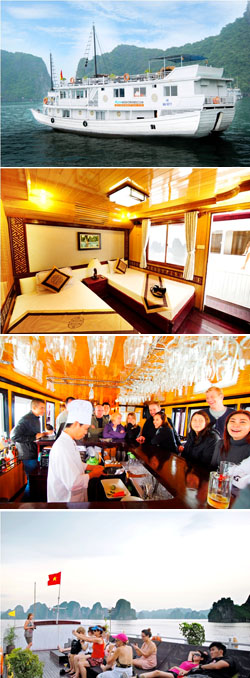
We welcome you on board Alova Gold Cruise I & II, timber junks built in 2011 those combine classic beauty with modern comfort. Aiming to serve small groups and families, we limit numbers of rooms up to 9 each. That means you will have your privacy and will not be disturbed by lots of passengers. We equip our cruises with all basically necessary facilities to make sure your safety and comfort with room service, food and beverages, entertaining & sunbathing area, kayaking, squid fishing. All above are our personal services coming from all crew members and tour guide who escorting you for the whole trip. We guarantee your satisfaction.
Alova Day Cruises are for Halong Bay 1 Day Tours
If you want to have a glint of breathtaking Halong Bay our daily full day tour would be the best choice. This join in tour offers you the overview of Halong Bay with at least 3,5+ hours cruising on Cruise Halong Bay
Alova Gold Cruise Halong bay


Discover Halong Bay aboard the Alova Day Cruise, a steel boat that combines classic beauty with modern comfort. With our hospitable crew and experienced tourguide will show you to explore tranquil scenery in the safest conditions. You will have a chance to know about the floating village, discover their lives and visit a beautiful cave on Halong Bay. If you want to do kayaking, it is also available on this tour, visiting Thien Cung cave & lunch. We guarantee you 100% satisfaction. We depart daily from Hanoi or Halong Bay, BaiChay Harbor. Still not sure check our reviews on TripAdvisor. Read more: Image CruiseCalypso Cruise

Each Alova Gold Cruise boasts a total of 9 comfortable cabins of 12m2 each. All cabins are equipped with own air-conditioned, private en suite bathroom with rain shower, basic amenities, comfortable bed with lamp, safety facilities, especially panoramic window to have Halong Bay in your eyes allowing you to enjoy the bay from the privacy. 
With the concept “Comfort & Food”, our restaurant meets all your demands with traditional cuisines paired with European styled flavors to satisfy passengers from different nationalities.
We design a cute but functional bar for you to enjoy a selection of local and international beverages. Here you can enjoy the beautiful scenery while drinking.

To make sure your privacy, you will find the open air up to the top equipped with tanning chairs to guarantee your comfort and quietness while cruising. Those cruises also have area with roof in case of raining or too strong of sunray.  The sundeck is dotted with green trees and dim lights hidden in bamboo covers to highlight the romance of tranquil bay.

We offer a wide range of fun activities as exploring cave, kayaking, swimming on beach, mountain climbing, squid fishing, cooking demonstration and flower carving with the hope to make you opportunities to feel the bay with unforgettable experience

Thứ Hai, 1 tháng 9, 2014

Pelican Cruise reviews

Starting to operate in early 2012, with the newest of the line sailing in the beginning of 2013, 3 junks on Halong bay Pelican Cruise fleet create a new sense of luxury for cruise trip at the charming Halong Bay. The cruises were constructed and designed with a style that was a combination of classic and modern wooden architecture. Entering the cruise makes passengers feel comfortable and cozy, and also a little superior sense. Read more: Halong Dragon Pearl Junk cruiseHuong Hai Sealife cruise Halong

Pelican Cruise reviews

Cabins
Each cruise of Pelican fleet is able to provide accommodations for maximum 44 passengers with 22 cabins classifying into 20 Deluxe cabins and 2 Royal Suites. These cabins offer travelers experience of a 5-stars standard with modern amenities, including air-conditioners, private bathrooms and large window, as well as elegant design to create an atmosphere of relaxing and coziness, and also elegance. In each cabin, there are also safety box for valuable assets and a minibar for some romantic drinks at night for couples.      
Activities on board
Not only in the cabins are great, but also the other public area are either. Restaurant on Pelican Cruises might not have unique features in décor, but the food is delicious with diverse menu, particularly Vietnamese and local seafood. And if passengers desire to have a private place, grab some drinks and witness the breathtaking sceneries of Halong or chat with friends, the terrace bar is an ideal place. Other services onboard, delivered by well-trained staff, are also outstanding features of the cruises, such as dinner at Tien Cave (Fairy Cave) or the Tai Chi sessions every morning at 6.30AM.