Thứ Năm, 30 tháng 10, 2014

Kỹ thuật cho hươu sao ăn

- Cho ăn đúng cách: Hươu giống chủ yếu hoạt động vào ban đêm, ban đêm hươu ăn tới 60% tổng số thức ăn của khẩu phần, vì vậy mỗi lần cho ăn trong ngày không nhiều, ban ngày hươu ăn ít mà dành thời gian nhai lại thức ăn qua đêm. Đây là một đặc điểm hết sức quan trọng mà người chăn nuôi cần nắm biết. Vì vậy lịch phân bố cho hươu ăn như sau:

Bữa thứ nhất: 6-7 giờ sáng cho ăn 15% thức ăn xanh.
Bữa thứ hai: 9-10giờ sáng cho ăn 15% thức ăn xanh.
Bữa thứ ba: 13-14 giờ chiều cho ăn 10% thức ăn xanh cộng với thức ăn tinh trong ngày.
Bữa thứ tư: 17 - 18giờ tối cho ăn 30% thức ăn xanh.
Bữa thứ năm: 22 giờ tối cho ăn 30% thức ăn xanh.

- Thức ăn tinh không được cho hươu ăn vào buổi sang vì ăn như vậy sẽ làm cho hươu ăn ít thức ăn xanh và thức ăn củ quả. Nên cho hươu ăn thức ăn tinh vào bữa ăn thứ ba vào lúc 13 – 14 giờ trong ngày. Hàng ngày người chăn nuôi phải thường xuyên theo dõi phân của hươu để điều chỉnh thức ăn cho hợp lý. Thường phân của hươu có dạng viên bóng, cứng hình bầu dục nếu khác với bình thường thì cần xem xét lại thức ăn cho hươu.
  Vận động – Tắm nắng – tắm chải.
Cho hươu ăn nhiều loại thức ăn xanh, đặc tính của chúng là thích ăn nhiều loại cỏ non, lá non và các loại cây có mủ. Không nên cho hươu ăn độc nhất một loại thức ăn thì sinh trưởng và phát triển, khả năng sản xuất cho nhung huou tuoi sẽ bị hạn chế.

 
Kỹ thuật cho hươu sao ăn
a). Vận động: Tuỳ thuộc vào hình thức nuôi khác nhau nên cho hươu vận động khác nhau. Hươu là động vật con mang tính hoang dã nên rất thích vận động, chạy, nhảy rất hiếu động nên khi bị bó hẹp trong nuôi nhốt thì rất khó chịu. Chúng ta nên tạo diện tích sân chơi cho hươu bằng cách khoanh vùng rộng bằng rào chắn cao 2 – 2.5m thì khả năng vận động và tắm nắng cuả hươu thịt được tốt hơn và thích nghi với điều kiện sinh lý của nó hơn, ít gây ra các hiện tượng ức chế(stree) con vật thoải mái hơn, góp phần tiêu hoá, trao đổi chất được tốt hơn.

Nếu không có điều kiện thì cần phải thiết kế mái che có lắp tấm kính có độ rộng 40X50cm cho nắng rọi vào 1giờ/ngày. Có thể thiết kế chồng cho nắng xuyên vào chuồng 7-8 giờ/ngày.

b). Tắm chải. Thứ tự tắm chải từ đầu đến mông, từ trên xuống dưới, mỗi lần chỉ cần 5- 10 phút. Trước khi tám chải phải tập làm quen với con vật để tạo cho nó có phản xạ có điều kiện. Trong quá trình tắm chải chú ý phát hiện một số ký sinh trùng nư ve, ghẽ, lỡ, loét…Nếu có hãy dùng các biện pháp sau đối với ve, ghẽ…

Bắt diệt liên tục bằng cơ học.

Dùng Ivermactin điều trị nội ngoại ký sinh trùng để tiêm 1ml/7kg trọng lượng.

Dùng các thuốc sát trùng ngoài da và khử trùng chuồng trại. Định kỳ dọn vệ sinh chuồng trại.

Sau đây chúng ta hãy tìm hiểu cụ thể cách nuôi dưỡng mỗi loại hươu.

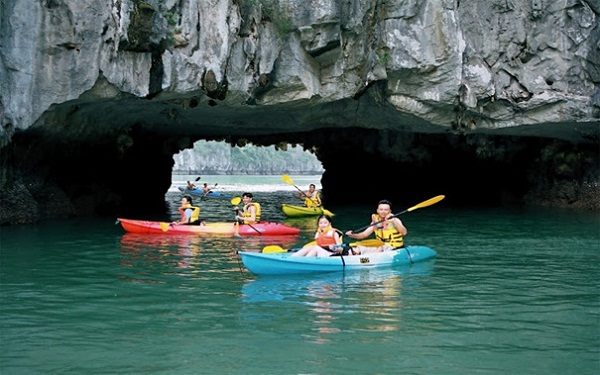
Halong Bay swimming activities

Halong Bay is a ideal travel destination - a World Heritage Site, with thousands of limestone islands and caves. There are countless places to stop for swimming, fishing, snorkeling and kayaking when cursing around islands. There are many charming and attractive beaches; it is suitable for swimming activities such as Tra Gioi Beach, Ba Cua Beach, Tuan Chau Beach, Titov Beach, Minh Chau Beach. Visit halong bay cruise
Halong Bay swimming activities
The stunning scenery of sheer mountain cliffs rising out of the bay makes an ideal backdrop to water-based activities.The water of beach is emerald green and turquoise color so you cannot see the bottom. Halong Bay is the safe place for swimming. Because beach is calm waters and tourists will be provided useful equipment such as: life jackets. Moreover the sailors and staff of the ship watched while you were swimming to alert you for dangers in case. Swimming in Halong bay is really nice and refreshing. visit halong long: 3 best places kayaking in Halong bay
 Swimming Safe guides:

- Check with the lifeguard on surf conditions before swimming. If lifeguards give you directions or instructions from the stand, obey them. Never swim alone - use the buddy system. 

- Don't overestimate your swimming ability, especially early in the summer when the water is cold. Swimming ability is severely decreased in cold water.

- Judge your ability to participate in beach activities based on your swimming skills without the assistance of rafts and other flotation devices.

- Never dive into shallow water, or water of unknown depth.

- If you are confronted by a large wave and there is not enough time to get away from it, try to dive underneath the wave. Keep your body as low as possible until the wave passes over you. Timing is important, dive into the base of the wave just before it breaks. Do not dive if the water is too shallow - instead crouch and keep a low body profile. travel to Vietnam

- If caught in rip currents, relax and swim toward the shore at a 45-degree angle until you are free of the current. If the rip currents are strong, swim parallel with the shoreline in the same direction as the littoral current and then swim diagonally toward the shore. If you are not able to swim out of the currents, call or wave for help.

- When body surfing, do not ride waves in a straight line toward shore. Instead, surf at an angle to the waves. Stay away from the white water in the wave center to avoid going "over the falls."

- Never swim while intoxicated. Alcohol impairs judgment, unnecessary risks are taken and a swimmer will tire more easily, increasing the chance of an accident.

Thứ Năm, 23 tháng 10, 2014

Chau Doc travel guide

Chau Doc Attractions

The main attraction in Chau Doc is the Sam Mountain, which is about seven kilometres north of town. The mountain is not really high, it just seems that way because of the plains of Mekong. This tourist destination is considered a local pilgrimage site because the mountain is home to many shrines and temples and there is a colourful temple at the base, and smaller places of worship on the way up the mountain. However, the most religiously significant is the Ba Chua Xu Temple, which has its own festival held between April and June. Visit Chau Doc with Mekong river tours

An attraction history lovers would surely appreciate is the Tuc Dup Hill. This is where the U.S. forces failed to stop the small-scale insurgencies in the delta. The hill was guarded and dominated by the Viet Cong during the U.S. assault, which lasted for four months. Near the hill, one will see graves and memorials.

Another attraction worth visiting in Chau Doc is the Tra Su Bird Sanctuary. It has a 23-metre high observation tower, enabling visitors to see over the reserve and the stunning countryside that surrounds it. With

Chau Doc Restaurants/ Dining Scene

When it comes to dining in Chau Doc, there are two restaurants that stand out: Bay Bong and Bassac Restaurant. The latter is upscale compared to the former, but both serve exceptional dishes which are enough reason to try them. Read more: South Vietnam tours

Bay Bong is a favourite dining destination for good a reason. Tourists who have tasted the dishes cannot help but rave about the cuisine and not only is the food delicious, but they are also reasonably priced. One is served with mouth-watering hot pots, soups and fresh seafood fare and the canh chua (sweet and sour soup) and ca kho to (stewed fish in clay pot) are highly recommended.
Chau Doc travel guide
Those who prefer a more sophisticated dining experience should head on over to the Victoria Chau Duc Hotel, where the Bassac Restaurant is located. Aside from amazing Vietnamese delicacies, its menu also includes a wide selection of international dishes. The dessert options in this place are impressive and diners can choose to eat either in the air-conditioned dining room or on the deck.

Chau Doc Nightlife

Chau Doc is a sleepy town, and locals usually retire to bed early. Nonetheless, visitors who will find themselves in Chau Doc after twilight can enjoy a few drinks and maybe even a dance. Chau Doc Night market

The four-star Victoria Chau Doc Hotel is probably the best place to stay in the Chau Doc region. Coincidentally, it is also where one can find one of the best bars in the city. The Tan Chau Salon bar is one of the nicest places to visit after a day of sightseeing. Aside from Asian and Western snacks, it offers great cocktails and is open until 23:00.

Couples who are interested in a nightcap can go to Gio Dong. The idyllic spot is located about two kilometres from town, on the way to the famous Sam Mountain.

For people who want more than a drink to end their night, An Tuong 2 is the place to go. This dance hall, which is a local favourite, has an entrance fee which is inclusive of one drink.

Chau Doc Shopping

Like other rural areas in Vietnam, Chau Doc has a floating market where one can find almost anything. The market expands from the bank of the river and along the streets of Le Cong Thanh Doc, Phu Thu, Bach Dang and Chi Lang. This is where most local products and commodities are sold. However, merchandise from Cambodia and Thailand can also be purchased here. Each floating 'store' has a long pole that shows a sample of the vendor's wares.

The wide selection of goods sold in this market is impressive. It is one of the best places to get fresh produce from the region. Most boats sell an assortment of fruit and vegetables. There are those that offer silk products, such as clothes and bags while others sell local embroidery, while there are some that hawk handicrafts and antiques.

Thứ Tư, 15 tháng 10, 2014

Mekong floating market

Cho Gao Floating Market
In the early morning, you could travel by your comfortable bus towards Can Duoc, where you come aboard of your boat to cruise to the Cho Gao floating market.
This sightseeing is extremely interesting as you participate in the life of the local people. The market is a melting pot of colors, shapes, sounds and smells. Rice, fresh fruit, fish, handicrafts, bonsais, almost everything is for sale, a great opportunity to find some nice souvenirs for the loved-ones at home! Read more: Mekong river tours
Phong Dien Floating Market
Boats loaded with produce from nearby orchards of the Mekong Delta converge to the floating market. They carry mostly fruits but also coconuts, vegetables and fishes.
Buyers are local traders with bigger boats snapping everything by the bushels and resell at local markets or to wholesale dealers from big cities, often for a handsome profit.
Large floating markets are not complete without its floating restaurants, floating gas stations and an occasional tour boat filled with tourists. 
Mekong floating market

Perhaps the best floating market in the Mekong Delta, Phong Dien has fewer motorised craft and more stand-up rowing boats. It's less crowded than Cai Rang and there are far fewer tourists. The market is at its bustling best between 6am and 8am.
It is theoretically possible to do a whirl- wind boat trip here, visiting the small canals on the way and finishing back at the Cai Rang floating market. This journey should take approximately five hours return from Can Tho.
Cai Be Floating Market
It is opened from 5am to 5pm. It is best to go early in the morning. Wholesalers on big boats moor here, each specialising in one or a few types of fruit or vegetable. Customers cruise the market in smaller boats and can easily find what they're looking for, as the larger boats hang samples of their goods from tall wooden poles.
One interesting thing you won't see at other floating markets is the huge Catholic cathedral on the riverside - a popular and fantastic backdrop for photographs.
It takes about an hour to reach the market from Vinh Long, but most people make detours on the way there or back to see the canals or visit orchards.
Phung Hiep Floating Market
The market meets all day long, but most noisy and busy in the morning. The precious evening, from far-and-wide, boats full of seasonal vegetables and fruits: mangoes, durians, bananas, oranges, coconuts... left their villages to head for the sunrise market. Every boat is full of fruits. Some boats are covered with roofs, some are not. On boats without roofs, the sellers have to hold high a stick hanging with fruits as signals. Market-goers do not bargain, just a few words exchange, they sell and get paid. Normally, fruits are sold and brought to big boats. Then they will be transported to fruit-processing factories or to Ho Chi Minh City, Vung Tau, even to Hanoi and Northern provinces.
It's a floating market' but services are available, foods and drinks on small boats twist and turn to serve hungry sellers and buyers. Signal to buy is only a whistling or waving band. Apart from fruits, local products: snakes, birds, turtles... are easy to find near Phung Hiep bridge. These specialties are almost bought and brought to restaurants in Can Tho or Ho Chi Minh City.
The atmosphere in Phung Hiep market was exciting, as we witnessed snake traders fearfully transferring poisonous copperheads, kraits, and rattlesnakes, from their cages to purchaser’s jute bags.
The price for a snake ranges from tens of thousands of dong for individual specimens, to hundreds of thousands of dong per kilogram. One kilogram of water snakes is priced at VND30, 000-VND50, 000 (US$1.88 - $3.13); while copperheads sell for between VND50, 000-VND400, 000 ($3.13 - $25) per kilo.
Second to the snakes in quantity at Phung Hiep market are wild birds. All species favoured by urban gastronomers such as cao, cu dat, stork, blosh dove, moorcook, and la mia, are sold at the market.
Birds are hanged up on the motorbikes of bird hunters from rural areas and confined in narrowed cages. Thousands of birds are purchased each hour, and transported to “headquarters” for retail sale to restaurants in Ho Chi Minh City and southwestern provinces.
Phung Hiep Snake Market, located close to the floating market, is known worldwide. Visitors from all over the world go there to taste the snake liquor and see the dangerous snake dance.

Thứ Năm, 9 tháng 10, 2014

Hon Chong travel guide

Whatever the tourist brochures tell you, Hon Chong is not the Halong Bay tours of the south -- it is as simple as that.

A few rock pinnacles and limestone karsts do not a Ha Long make.

That doesn't mean that it isn't a worthwhile destination in its own right, however. A welcoming seaside village set on a rugged coastline, Hon Chong makes for a decent R&R stop on any Mekong tour. This is especially the case if you're headed towards Cambodia for the overland crossing with Kep. Read more: V'spirit cruise Halong bay

Though it sees a flood of Vietnamese holidaymakers around Tet, it can feel practically deserted for the rest of the year, making it the ideal locale to lay back in a hammock and unwind.
Hon Chong travel guide


Though the town's sole road fronts along a lovely pine-tree fringed beach, the swimming in Hon Chong isn't very good. The sand is too slimy, and the water too shallow -- those fisherman walking 20m from shore? They aren't on stilts. Read more: Vietnam tours

But the sand is still great for getting some sun, or enjoying a seafood lunch. You feel more active than this, the Chua Hang Grotto makes for a worthwhile afternoon out.

Orientation
Hon Chong consists of only one beachfront road, along which all the town's hotels and restaurants are located. There is no hospital, bank or post office here, though on a good day, Ha Tien is only a few hours away over a dreadful road.

Internet doesn't seem to have quite made a splash in Hon Chong yet. For the moment, An Hai Son Resort has WiFi available in their restaurant, and you may be able to convince them to let you use one of the computers in their office.