Thứ Tư, 28 tháng 1, 2015

What to see in Hue

What to see in Hue
Hue is a pretty city, criss-crossed by dozens of bridges, lakes, moats and canals. On the river’s north bank is the ancient imperial citadel and residential areas, while the new commercial area, the old French quarter and the hotel district are all on the south bank. Further south are several tombs that belong to the emperors of the Nguyen dynasty.

Kinh Thanh - the Citadel

On the northern side of the Perfume River, Hue’s Citadel (Kinh Thanh) covers some 520 hectares (1,285 acres) and is enclosed by a wall made of stone, brick and earth and measuring 8 metres (26ft) high and 20 metres (65ft) thick. Centre Vietnam tours

Entry to the Citadel is by way of 10 fortified gates, each of which is reached by a low, arched stone bridge across the moat. In imperial times a cannon would sound at 5am and 9pm to mark the opening and closing of the gates. The area within the Citadel comprises three enclosures, the first of which was formerly used to accommodate various royal ministries and which today constitutes a pleasant area of parks, gardens and quiet residential districts. Here may be found the Sung Than Cong (Nine Deities Cannons), kept in buildings flanking the gates on either side of the Flag Tower. 5 best cruises in Halong Bay
What to see in Hue
What to see in Hue

Yellow City
A second moat and defensive wall within the Citadel guard the Hoang Thanh (Yellow City), deliberately modelled on the Forbidden City in Beijing. This inner city has four gates, the chief of which is called Cua Ngo Mon (Meridian Gate, also known as the Noon Gate). This majestic structure, built during the reign of Emperor Minh Mang in 1833, is among the finest surviving examples of Nguyen architecture. The central entrance, reserved exclusively for the emperor, is flanked by smaller passages for the use of mandarins and court officials; these in turn are flanked by two much wider passages intended for the royal elephants. Above the Cua Ngo Mon rises Five Phoenix Watchtower where the emperor sat in state during important ceremonies. 2 days to the Floating Markets

Beyond the Ngo Mon Gate, Kim Thuy Kieu (Bridge of Golden Waters), leads between lotus-filled ponds to Dien Thai Hoa (Palace of Supreme Harmony). This was the throne room of the Nguyen Kings, and is the best preserved of Hue’s surviving palaces. Built by Gia Long in 1805, its yellow-tiled roof is supported by 80 massive wooden columns, lacquered a deep red and decorated with imperial golden dragons.

Forbidden Purple City
Immediately behind the throne room, Dai Cung Mon (Great Golden Gate) once led through to Tu Cam Thanh (Forbidden Purple City). This used to be the sole preserve of the emperor, his queen, his many concubines and female palace servants. No man but the king could set foot here on pain of death – imperial sons were banished when they reached puberty, and the only non-females permitted within the inner sanctum were palace eunuchs. In imperial times the Purple City consisted of more than 60 buildings arranged around 20 courtyards, but it was seriously damaged by fire in 1947 and all but destroyed during the Tet Offensive of 1968. Restoration work, based on surviving photographs, plans and some degree of imagination, was begun in the mid-1990s and is now well under way.

Just southwest of the Forbidden Purple City is an area with numerous temples and smaller palaces. Cuong Dien Tho (Dien Tho Palace) was the traditional residence of various queen mothers and contains more than 20 structures, including the lovely Truong Du ?Pavilion, nestled against a small lotus pond. Completely restored, the magnificent Hien Lam Cac (Pavilion of Splendour), towers above the Cuu Dinh (Nine Dynastic Urns). The urns, cast during Minh Mang’s reign, are decorated with motifs of nature ?and daily life, dragons and historic events.

Perfume River

Any visit to Hue should certainly include a boat trip on the beautiful Perfume River. Boats are readily available for hire, either for a relaxing trip in the vicinity of Hue, or for a longer journey upstream to the tombs of Minh Mang and Gia Long. Night journeys on the river with musical ensembles playing traditional court music can be arranged and are an enchanting experience.

The Imperial Tombs

Scattered across the countryside to the south and west of the city, the Tombs of the Nguyen Emperors are, together with the Citadel, Hue’s greatest attraction. These seven tombs, all of which have features of outstanding architectural merit, are often strikingly different.

Thứ Hai, 26 tháng 1, 2015

Làm thế nào để chia hệ thống công trình điều hòa không khí?

Làm thế nào để chia hệ thống công trình điều hòa không khí?
Mặc dù hệ thống dieu hoa gia re trong nước có thể được coi là một cái gì đó của một lãng phí, không thể phủ nhận rằng trong vài mùa hè qua đã được ấm hơn bình thường, với nhiệt độ thường xuyên đạt đỉnh khoảng 30 ° c đánh dấu trong suốt tháng Sáu và tháng Bảy. Đảm bảo rằng bạn và gia đình của bạn ở lại mát mẻ, sau đó, chưa bao giờ quan trọng hơn. Hệ thống chia may mắn thay không ống dieu hoa am tran chinh hang - hoặc là họ cũng được gọi là, điều hòa không khí mini-chia - là hoàn hảo cho cả hai, tính chất thương mại hoặc công nghiệp dân cư và rẻ hơn so với bạn nghĩ.
Hệ thống điều hòa không khí làm việc trong cùng một cách như tủ lạnh tiêu chuẩn của bạn; họ trích xuất các hạt không khí ấm áp từ xung quanh nhà và chuyển nó trở lại vào bầu không khí trong nhà như không khí mát mẻ. Về cơ bản là không khí nóng chiết xuất đi qua một loạt các cuộn dây áp lực để cho phép nó tiêu tan nhiệt và ngưng tụ thành chất lỏng mát mẻ. Chất lỏng này sau đó được gửi thông qua một van mở rộng mà nó bốc hơi như một loại khí lạnh hơn, mà sau đó được phát hành vào phòng chính của toà nhà để hấp thụ bất kỳ nhiệt còn lại và hạ nhiệt toàn bộ khu vực.
Hệ thống phân chia làm việc theo cách tương tự, nhưng với hai phần riêng biệt - một tụ nén ngoài trời và một đơn vị xử lý trong nhà (trong đó bao gồm các cuộn dây làm mát và quạt làm mát). Về cơ bản, điều chỉnh nhiệt trong nhà đồng thời kiểm soát cả hai thành phần riêng biệt; hai được kết nối thông qua một đoạn ống có chứa các chất làm lạnh, nơi nhiệt độ thấp, khí áp suất thấp được chuyển thành nhiệt độ cao, khí áp suất cao. Các fan hâm mộ tụ trong máy nén ngoài trời sau đó trục xuất nhiệt, để lại một áp suất cao, khí đốt ở nhiệt độ thấp được chuyển giao lại cho các đơn vị trong nhà và bị trục xuất khi cần thiết.
Những lợi ích của hệ thống điều hòa không khí chia là gì?

Như một dieu hoa lg Inverter  di động, hệ thống phân chia nhỏ, thường không dễ và đến trong một loạt các thiết kế để phù hợp với hầu như bất cứ nơi nào trong nhà của bạn. Chúng thường được thiết kế để trộn với trang trí nội thất - làm cho chúng thích hợp hơn để các thiết bị di động cồng kềnh cần liên tục mở các cửa sổ để hoạt động đúng. cũng cũng rất dễ dàng lắp đặt điều hòa
Các đơn vị máy nén ngoài trời cũng có thể được trang bị một 'liên kết đoạn' của bất cứ chiều dài bạn thích - cho phép bạn lưu trữ nó ra khỏi cảnh, trên một mái nhà bằng phẳng có thể, hoặc ở mặt sau của khu vườn của bạn trong một nhà kho hoặc nhà để xe.
Với một hệ thống chia nhau khu vực (phòng) có nhiệt riêng của mình quá, vì vậy bạn chỉ cần phòng mát và khi bạn cần phải - tiết kiệm năng lượng và tiền bạc trong thời gian dài.
Điều này cũng làm cho chúng hoàn hảo cho các tòa nhà có nhiều hơn một gia đình cư trú, hoặc cho ngôi nhà có một bổ sung, gia hạn trước đây không có kế hoạch mà nó sẽ là tốn kém và không thực tế để bắt đầu mở rộng mạng lưới phân phối của hệ thống điều hòa không khí cũ của bạn.
Họ là cực kỳ yên tĩnh và có thể được sử dụng cho nghiên cứu của, phòng ngủ và thậm chí cả thư viện; nhiều hơn thích hợp hơn với người hâm mộ điện ồn ào mà chỉ đơn giản là thổi không khí nóng xung quanh phòng chứ không phải thay thế nó. hơn nữa chúng cũng rất dễ ràng bảo dưỡng điều hòa
Như hệ thống truyền thống, điều hòa không khí chia cũng có thể được thực hiện đồng thời có chức năng như một máy - cho bạn hai sử dụng riêng biệt cho một máy.
Bao nhiêu chi phí hệ thống điều hòa không khí chia rẽ?
Chi phí của hệ thống điều hòa không khí chia thường được trích dẫn như đắt hơn một hệ thống được trang bị truyền thống - gần như lên đến 30% hơn - nhưng điều đó chỉ đưa vào cài đặt tài khoản. Một khi bạn đã có hệ thống của bạn và chạy, máy điều nhiệt cá nhân của bạn sẽ giúp bạn theo dõi việc sử dụng năng lượng hiệu quả hơn nhiều, cho phép bạn tiết kiệm đồng xu thêm trong thời gian dài. Giá cuối cùng sẽ phụ thuộc vào một số yếu tố, bao gồm cả số phòng bạn cần nó cho và chất lượng của hệ thống thông gió hiện trong nhà của bạn; nhưng để có được những thỏa thuận tốt nhất luôn luôn cửa hàng xung quanh và so sánh giá giữa một số chuyên gia. Bạn có thể, tuy nhiên, tính toán mức giá trung bình với các khoản sau:
400-500 chân vuông của căn phòng đòi hỏi một tấn A / C.
Một tấn A / C có giá khoảng £ 1.200 đến £ 1.400.
Vì vậy, nếu ba tấn A / C có giá khoảng £ 3500 và năm tấn chi phí khoảng 6.000 bảng Anh, sau đó 2000 mét vuông của bất động sản sẽ có một nơi nào đó khoảng £ 5.000. Hãy nhớ rằng, đây là những chỉ là ước lượng và nếu bạn đang lo lắng về đi qua ngân sách và muốn một sự phản ánh chính xác hơn về chi phí của bạn, bạn luôn luôn có thể thuê một điều tra viên để đo nhiệt Lãi / lỗ kiểm toán của nhà bạn và do đó xác định kích thước thích hợp của không khí chia hệ thống điều bạn sẽ cần. Nó có vẻ phức tạp và tốn kém, nhưng một khi cài đặt chuyên nghiệp bạn

Thứ Ba, 20 tháng 1, 2015

Cuc Phuong National Park Wildlife and caves

Cuc Phuong National Park Wildlife and caves
Cuc Phuong National Park was established in 1962 and consists of over 200km of tropical forest and many grottoes. This reserve is rich in wildlife and natural beauty although it has suffered at the hand of logging companies. Hanoi – Sapa train, the best choice to travel from Hanoi to Sapa

The park also possesses historical significance as prehistoric tools were discovered in 1974 in two of the park's grottoes, Hang Dang and Con Mong, and ancient tombs were discovered in another grotto, Nguoi Xua. This cave is reached by a long staircase and contains many stalactites in bizarre shapes. Some of the other caves are inhabited by thousands of bats. Indochina sails – Halong Bay travel

While there is no guarantee you will see many animals during your visit, the park offers some stunning walks and the serenity of the places makes a welcome change from busy Vietnamese cities. There are lots of scenic trails, a Visitor's Centre and an Endangered Primate Rescue Centre (EPRC) with about 130 monkeys near the park's entrance. 
Cuc Phuong National Park Wildlife and caves

If you're planning on doing the park in a day trip, drive to the park's centre (a 20km beautiful drive from the park's entrance) and walk the 8km loop trail that leads you to the 1,000 year old tree. Beware of leeches during rainy season. Alternatively if you've got more time, you can spend the night in one of several areas in the park: there are several bungalows, stilt houses and even homestays in a Muong village to choose from. Check out the website for up to date information about accommodation prices.

Entrance to the Park costs 20,000VND, the EPRC 30.000 VND -- make sure you buy your ticket at reception before going to the centre.

If you have time on the way back to Ninh Binh, you can stop at the Kenh Ga floating village or the Van Long nature reserve, both are located a few kilometres before Highway 1. Van Long nature reserve offers the same scenery as in Tam Coc with Cuc Phuong's animals thrown in, and the boat trips are much less touristy than in Tam Coc or Trang An.

It is possible to visit the park as a long day trip from Ninh Binh but you will spend most of the day travelling -- the 52 km drive will take a couple of hours each way. Take a good map since the way to the park is not very well indicated. Alternatively stay overnight. If you aren't visiting Ninh Binh but are travelling to Cuc Phuong directly from Hanoi you can drive via the Ho Chi Minh Highway, rather than Highway 1. It's a bit further but more attractive and not as busy.

Thứ Bảy, 17 tháng 1, 2015

Thị trường điều hòa cuối năm

Lượng bán ra hàng trăm bộ/ngày

Riêng đối với Siêu thị điều hoà VinaCore của Công ty Cổ phần Xây dựng và Kỹ thuật lạnh Việt Nam (VinaCore Group), những ngày nắng nóng này, lượng dieu hoa bán ra lên tới 200 - 300 bộ/ngày, thậm chí những ngày cao điểm còn lên tới 500 bộ/ngày.
“Với lượng hàng bán ra quá lớn mỗi ngày nên vấn đề nan giải nhất đối với công ty hiện nay vẫn là lắp đặt”, ông Nguyễn Cảnh Ngọc, Phụ trách Kinh doanh của VinaCore Group chia sẻ.

Hiện đội ngũ lắp đặt của công ty này lên tới gần 60 người, nhưng vẫn không đủ để cung cấp cho thị trường vì phải kết hợp với làm công trình.

Do vậy, để giải quyết vấn đề này công ty buộc phải đưa ra hai hình thức hình thức hỗ trợ cho khách hàng. Hình thức thứ nhất là bán lẻ với giá bán buôn, trừ tiền cho những khách hàng mua sản phẩm nhưng không yêu cầu lắp đặt. Đối với hình thức này, số tiền khách hàng có thể tiết kiệm lên tới 200.000 - 500.000 đồng tùy loại máy.

Hình thức thứ hai, VinaCore khuyến khích những khách hàng lấy máy và hẹn trước thời gian lắp đặt dieu hoa funiki, khi đó khách hàng sẽ được trừ thẳng vào giá bán từ 100.000 – 200.000 đồng/bộ (tuỳ theo thời gian hẹn).

Mặc dù, khá khó chịu với sự nắng nóng của thời tiết nhưng trong tình hình hiện nay, nhiều khách hàng cũng vẫn phải chấp nhận phương án chờ để có được sản phẩm ưng ý và chất lượng lắp đặt đảm bảo.

Anh Công Minh (Mê Linh – Hà Nội) cho biết để có được chiếc dieu hoa lg ưng ý anh đã phải đặt trước cả tuần mới có hàng và người lắp đặt.
Thị trường điều hòa cuối năm


Tuy đã được phía siêu thị thông báo do người mua hàng khá nhiều và đặt hàng trước, nhưng chị Kim Thu (Thành Công – Hà Nội) vẫn khá sốt sắng vì 2 ngày rồi mà chiếc điều hoà Panasonic tiết kiệm năng lượng mà gia đình chị đã chọn mua vẫn chưa được giao hàng và lắp đặt.

Lượng khách có nhu cầu mua điều hoà tăng đột biến cũng đã khiến giá bán lẻ của nhiều sản phẩm chỉ trong vòng chưa đầy 1 tuần đã tăng thêm từ 100.000 – 300.000 đồng/bộ.

Song, theo ông Cảnh Ngọc, thời điểm này vẫn chưa phải là “đỉnh” của mùa điều hoà. Hiện nguồn hàng khá dồi dào do các tổng đại lý vừa nhập hàng để chuẩn bị cho mùa nóng và tình trạng “găm” hàng vẫn chưa diễn ra.

Nhưng đến cuối tháng 5, đầu tháng 6, giá bán có một số loại điều hoà có thể sẽ tăng lên từ vài trăm nghìn tới trên 1 triệu đồng/bộ so với bây giờ. Năm trước vào giai đoạn cao điểm của nắng nóng, người tiêu dùng chấp nhận giá cao cũng không mua được do phần lớn các “đầu nậu” muốn găm hàng lại để đẩy giá lên mặt bằng mới.

Do đó, lời khuyên đối với người tiêu dùng vẫn là nên mua khi thị trường chưa “sốt” để có mức giá hợp lý, chất lượng lắp đặt đảm bảo do thợ không phải chạy “sô” vì số lượng đơn hàng quá lớn.

Hai xu hướng cùng song hành

Về xu hướng lựa chọn điều hoà trong năm nay, hiện đang có hai xu thế rất rõ rệt dù đối ngược nhau đó là “chuộng” cả điều hoà cao cấp tiết kiệm điện (tích hợp công nghệ biến tần inverter) và điều hoà giá rẻ với những tính năng cơ bản.

Ông Ngọc cho rằng việc có hai xu thế đối nghịch cùng tồn tại song song là điều hợp lý trong giai đoạn này. Yếu tố đầu tiên tác động tới quyết định mua của người tiêu dùng chính là lạm phát, chỉ số giá không ngừng tăng cao trong thời gian qua. Điều này khiến người tiêu dùng phải cân nhắc hơn trong các khoản chi tiêu. Vì vậy, một bộ phận có xu hướng mua điều hòa cơ bản, giá rẻ để giải quyết tạm nhu cầu giải nhiệt trong mùa nóng.

Nhưng lại có yếu tố tác động thứ hai tác động đến xu hướng mua điều hòa khác là giá điện. Giá điện tăng cao và dự báo tiếp tục tăng khiến đại đa số người mua điều hòa phải cân nhắc trước khi quyết định. Hiện điều hòa không khí vẫn là vật dụng “ngốn” điện nhất trong mỗi gia đình. Với một gia đình việc sở hữu từ 2 - 3 máy điều hòa trong nhà sẽ tiêu tốn tiền điện lên tới trên cả triệu đồng/tháng và đó là gánh nặng tài chính khá lớn trong mùa bão giá.

Thứ Tư, 14 tháng 1, 2015

My Tho travel guide

Buses coming southwest of bustling Ho Chi Minh City rise from the urban sprawl into the verdant fields of the Mekong’s plains. The Delta’s shy demeanor teases by only giving glimpses of its raw beauty through the lush rice fields with their golden skin interspersed with a splendid green tinge. 70km out of Ho Chi Minh City is My Tho, a quaint and charming town that lies on the northern bank of the Mekong River, the Tien Giang.

My Tho’s close proximity to Ho Chi Minh City translates into a lion’s share of day trippers visiting the Mekong Delta. The large number of day trippers to My Tho has developed pushy vendors that crowd around tour buses that arrive. Nonetheless, the town is a welcome relief from the hustle and bustle of Ho Chi Minh City. Enjoy the un-crowded boulevards, wander the backstreets, and explore the town by boat to experience all that My Tho has to offer.
A recommended stop is Thai Son Island, where the local villagers have a thriving business cultivating bonsai trees. The island is filled with varieties of fruit trees and plants. Travel to Vietnam
My Tho travel guide
My Tho travel guide

Distance: 75km from HCMC.
Access by car / bus: 2hr

Vinh Trang Pagoda

The pagoda is a beautiful and well-maintained sanctuary. The charitable monks here provide a home to orphans, disabled and other needy children. The pagoda is about 1km from the city center.

Distance: centre of town.
Access by car / bus: 15min
Entrance fees: no

Thoi Son Islands

This is the highlight of a visit to My Tho including sampan cruise through the maze of small canals and visit to local friendly families and tasting fruits in orchid gardens.

Dong Tam Snake Breeding Farm

Dong Tam is the centre of snake breeding for taking venom for exportation, as well as medicinal plant cultivation and the study and treatment of snakebites, for people in the Cuu Long River Delta. There is a snake-breeding zone with dozens of species to feed or even to play with. There are also crocodiles and other species of birds and animals on hand.

Distance: 9km from My Tho town.
Access by car / bus: 30min

Thứ Tư, 7 tháng 1, 2015

Hoi An- the peaceful meeting place

The name “Hoi An” means “peaceful meeting place”. In the past, Hoi An ancient town was an international trading center and also the busiest commercial port in the South Region of Viet Nam. Officially recognised as World Cutural Heritage by UNESCO in 1999, Hoi An has been a very interesting destination to visit during your trip to Vietnam and Indochina. Travel to Vietnam
The town has old-world charm in abundance and world-class attractions that include spectacular beaches and resorts fit for sun-worshiping couples.

Hoi An is a special example of a traditional trading port in South-East Asia which has been completely and assiduously preserved: it is the only town in Viet Nam that has survived intact in this way. Most of the buildings are in the traditional architectural style of the 19th and 20th centuries. They are aligned along narrow lanes of traditional type. They include many religious buildings, such as pagodas, temples, meeting houses, etc., which relate to the development of a port community. The traditional lifestyle, religion, customs and cooking have been preserved and many festivals still take place annually. Jasmine Cruise – Halong Bay
Archaeological finds and excavations have shown that there was a port and trading centre of the local Sa Huynh people along the Thu Bon River as early as the 2nd century BC. This continued to expand, especially during its most flourishing period from the late 16th to the early 18th centuries. It was through Hoi An that Christianity penetrated Vietnam in the 17th century. Mekong Delta tour
By the end of the century, the rise of other ports on the coast of Vietnam, in particular Da Nang, and silting of its harbour, led to the final eclipse of Hoi An. As a result of this economic stagnation, it has preserved its early appearance in a remarkably intact state, the only town in the country to have done so. The ancient town is situated on the north bank of Thu Bon River. There is a street running east-west along the river's edge and three further streets parallel to the river. They are intersected at right angles by streets and alleys. Within this area there are houses (often combined with shops), religious monuments such as pagodas, temples, communal houses and family cult houses, a ferry quay and an open market.
Hoi An- the peaceful meeting place

The architecture of Hoi An, which is almost entirely of wood, is of considerable interest. It combines traditional Vietnamese designs and techniques with those from other countries, above all China and Japan, whose citizens settled there to trade and built houses and community centres to their own designs.
The typical house conforms to a corridor plan, the following elements occurring in sequence: house, yard and house. The buildings are: family cult houses, dedicated to the worship of ancestors; the community houses, used for worship of ancient sages, founders of settlements, or the legendary founders of crafts; the pagodas are almost all from the 19th century, although inscriptions show them to have been founded in the 17th and 18th centuries. They conform to a square layout and decoration is largely confined to the elaborate roofs. In the case of the larger examples, they constituted nuclei of associated buildings with religious and secular functions. Some of the larger pagodas also served as meeting halls. These are located along the main street (Tran Phu).
There is a fine wooden bridge, reminiscent of Japanese examples, with a pagoda on it. It has existed from at least the early 18th century, as an inscription indicates, but it has been reconstructed many times. There is also a number of ancient tombs in Vietnamese, Japanese and Chinese style within the buffer zone.

Thứ Sáu, 2 tháng 1, 2015

3 Islet Halong bay

Dua Islet - In Bai Tu Long Bay
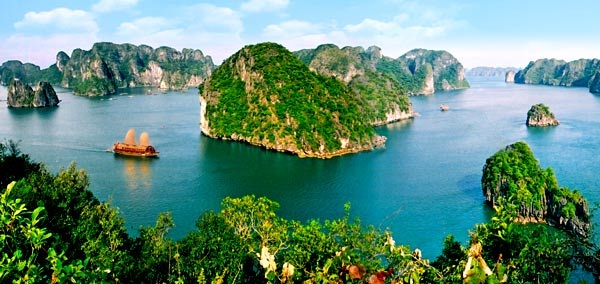
In Bai Tu Long Bay, some 7 km east of Bai Tho (Poem) Mountain stands a stone islet, which resembles a huge magic wand in Andersen’s fairy tales. It clarifies the geological and geomorphologic significance of Ha Long Bay. Dua Islet serves as an interesting tourist site and a “lighthouse” for seagoing boats. halong bay cruise

In Bai Tu Long Bay, some 7 km east of Bai Tho (Poem) Mountain stands a stone islet, which resembles a huge magic wand in Andersen’s fairy tales. It clarifies the geological and geomorphologic significance of Ha Long Bay. Dua Islet serves as an interesting tourist site and a “lighthouse” for seagoing boats  Halong Bay 2 day – itinerary
Su Tu Bien Islet - Halong Bay
On the canoe route to Thien Cung - Dau Go Grottoes, one should visit Hon Su Tu Bien or Sea Lion Islet, which is 10 minutes away from the Bai Chay Tourist Wharf.
Amidst the vast seawaters of Ha Long, you recognize a high rock jutting from the sea, resembling a lion stretching. Lost in the maze of Halong Bay caves
3 Islet Halong bay
3 Islet Halong bay

Oan Islet - Halong Bay
Situated 300 m away from Bai Tho Mountain and 5 km from the Bai Chay Tourist Wharf, a 22-meter islet stands out in Bai Tu Long Bay
It has the shape of truncated sticky rice, which serves as an offering to Buddha. French tourists pay special attention to this rock as in 1992; a French famous actress came there to film some shots of the film Indochina.
In the island, some settings are still preserved including the stone-paved road to the beach (often called the Slave Pier), the prisons.